Have you ever wondered why old-fashioned Christmas tree lights would all plunge into darkness the moment a single bulb blew? That frustrating scenario is the perfect introduction to understanding how electricity flows through your home. If you are upgrading your home’s illumination or planning an extension, understanding the debate of wiring lighting circuits in parallel vs. in series (and why parallel is usually the best choice) is absolutely essential.
Whether you are fitting modern downlights or simply trying to understand your home’s electrical layout, getting to grips with electrical wiring basics will save you time, money, and a lot of headaches. In this comprehensive guide, we will explore the fundamental difference between series and parallel lighting circuits, explain why modern homes are wired the way they are, and share practical tips for a safe, brilliant result.
Electrical Wiring Basics: Series vs. Parallel
At its core, a lighting circuit is a path that allows electricity to travel from your consumer unit (fuse box) to your light fittings and back again. The way this path is structured dictates how your lights behave. There are two primary methods used to connect multiple components in an electrical circuit: series and parallel.
To understand which method is superior for domestic properties, we need to look closely at how each one functions, how they handle electrical current, and what happens when things go wrong.
The Chain Reaction: Understanding Series Circuits
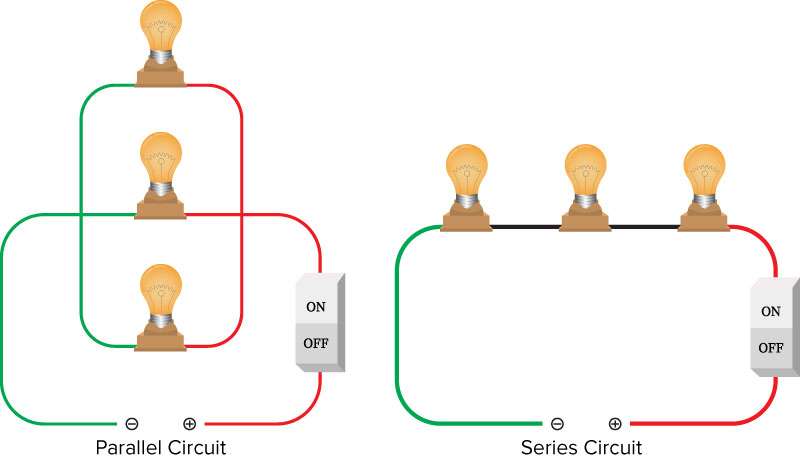
In a series circuit, all the components are connected end-to-end, forming a single, continuous loop. The electricity flows through the first bulb, then the second, then the third, and so on, before returning to the power source.
While this sounds wonderfully simple, it presents several significant problems for household lighting:
- The domino effect: Have you ever wondered why one bulb out affects the whole circuit? In a series setup, the electricity only has one path. If a bulb fails, this interrupts the circuit’s continuity. The flow of electricity stops instantly, and every light on that run goes dark.
- Diminishing returns: Understanding what happens to voltage in a series circuit reveals another major flaw. The total voltage supplied by the mains (230V in the UK) is divided across every load (bulb) in the circuit. If you have four identical bulbs, each only receives a quarter of the total voltage (57.5V).
- The brightness issue: Because of this voltage division, fixing dim light bulbs in series connections is impossible without removing bulbs or completely rewiring the system. The more lights you add, the dimmer they all become. Furthermore, you will experience a significant voltage drop in long series lighting runs, leaving the bulbs at the end of the line glowing faintly, if at all.
Because of these severe limitations, series circuits are almost never used for main household lighting today.
The Champion of the Home: The Parallel Circuit
So, why are house lights wired in parallel? The answer comes down to reliability, performance, and safety.
When wiring lighting circuits in parallel, each light fitting has its own independent connection to the live and neutral wires. Instead of electricity having to force its way through one bulb to reach the next, the current splits. It travels down multiple parallel branches simultaneously.
The Benefits of Parallel Wiring for Home Lighting
Wiring lights in parallel offers a host of advantages that make it the gold standard for electricians worldwide:
- Consistent Brightness: In a parallel circuit, every single branch receives the full mains voltage. Whether you have one bulb or ten, each receives the full 230V. This is the secret to maintaining constant brightness across multiple fixtures, ensuring your kitchen or living room remains brilliantly lit without any dimming.
- Ultimate Reliability: Because each light operates on its own branch, a blown bulb will not break the entire circuit. The broken bulb simply turns off, whilst the rest of the lights continue to shine brightly.
- Flexibility and Control: Parallel configurations allow for independent light control in parallel circuits. You can easily introduce multiple switches to control different branches of the circuit, giving you the flexibility to create zoned lighting in larger open-plan spaces.
- Easier Upgrades: Want to add another light fixture? With parallel wiring, you can tap into the existing live and neutral cables without reducing the voltage supplied to your existing lights.
Practical Application: How to Wire Lights in Parallel
Now that we have established the clear winner, let’s look at how this works in practice. Please note: electrical work in the UK can be dangerous and must comply with strict safety standards. Always isolate the mains power at the consumer unit before opening any fittings, and if in doubt, hire a qualified, registered electrician.
Daisy Chaining vs. Loop-In Loop-Out
You might hear contractors talk about a daisy chain light fixture installation. In computer networking and electronics, a true daisy chain is a series connection. However, in domestic electrical terminology, “daisy chaining” usually refers to a loop-in, loop-out parallel system.
In a modern UK home, this is typically done at the ceiling rose or at the light switch. The main supply cable comes into the first fitting’s live and neutral terminals. From those exact same terminals, another cable is “looped out” and run to the next fitting, and so on. Even though the physical wire hops from one light to the next, electrically, the connections are parallel.
Wiring a Junction Box for Parallel Lights
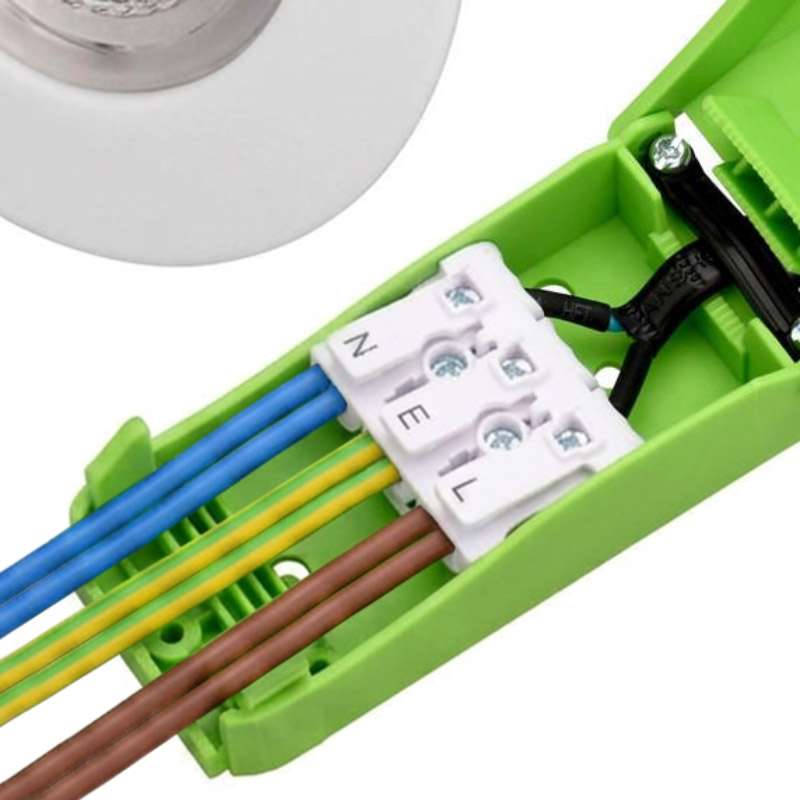
In installations without ceiling roses – such as banks of downlights or certain wall fittings – it is common to use an accessible junction box to create the parallel “split” from a single feed. The exact accessories and terminal design will vary, but the fundamental process remains the same:
Earth Eires:
Gather all earths (typically green/yellow sleeved). If the junction box is metal, connect one earth to the internal earth terminal/screw. Then connect all earths together using a suitable connector and place them neatly to the back of the box.
Neutral Connections:
Group and twist all neutrals (typically blue) together and join them all together using a suitable connector; the neutral circuit remains continuous through the junction box and out to each light fitting.
Live and Switched-Live Connections:
Incoming live (feed): The incoming live (typically brown) provides power into the junction box – connect it to the wire feeding the wall switch (i.e., the permanent live to the switch).
Return from switch (switched live): Take the returning switched-live wire from the switch and connect it to all the other live wires feeding each light fitting. This is what ensures all the lights operate in parallel: each fitting receives the same switched live and the same neutral, rather than being fed “through” another lamp.
Connecting Multiple Pendant Lights to One Switch
A popular interior design trend in the UK is hanging three or four pendant lights over a kitchen island or dining table. Connecting multiple pendant lights to one switch is remarkably straightforward using parallel wiring.
You can either wire them individually back to a large junction box hidden in the ceiling void, or you can loop the cables from the first pendant to the second, and from the second to the third (ensuring live joins to live, neutral to neutral, and earth to earth). Because they are in parallel, flipping the single wall switch sends full voltage to all three pendants simultaneously, ensuring they all burn with equal intensity.
Troubleshooting and UK Regulations
Even with the superior reliability of parallel circuits, faults can still occur. Understanding the setup makes identifying the problem much easier.
Finding the Fault
One of the great advantages of parallel wiring becomes apparent when troubleshooting open circuit faults in lighting. An open circuit means there is a break in the wiring.
- In a series circuit: An open circuit anywhere shuts down the whole house, turning fault-finding into a tedious guessing game.
- In a parallel circuit: If only one light is off but the rest are on, you instantly know the fault is isolated to that specific branch. It could be a blown bulb, a loose wire in that specific fitting, or a broken socket. If all the lights on the circuit fail simultaneously, the issue is likely at the consumer unit (a tripped MCB or blown fuse) or a break in the main feed cable before it reaches the first junction box.
Electrical Code Requirements for Residential Lighting
If you are undertaking DIY electrical work, you must be aware of the electrical code requirements for residential lighting. In the UK, all domestic electrical installations must comply with BS 7671 (The IET Wiring Regulations) and Part P of the Building Regulations.
Part P dictates that anyone carrying out electrical installation work in a home must make sure that the work is designed and installed to protect people from fire and electric shocks. While you can change a light fitting or a switch yourself, installing a completely new circuit or working in a “special location” (like a bathroom) often requires a Part P registered electrician to certify the work.
When an electrician signs off on a new parallel lighting circuit, they will test the earth loop impedance, check the insulation resistance, and ensure that the cables are correctly sized to carry the load without overheating. This guarantees that your beautiful new parallel lighting setup isn’t just bright—it is entirely safe.
The Final Verdict
When evaluating the merits of wiring lighting circuits in parallel vs. in series (and why parallel is usually the best choice), the conclusion is absolute: parallel wiring is the undisputed king of domestic electricity.
While series circuits have their place in very specific electronic components and internal device circuitry, they are entirely unsuitable for lighting a modern home. Parallel circuits eliminate the frustration of a single blown bulb killing the whole room’s light, they prevent frustrating voltage drops, and they guarantee that every single light fitting shines at its absolute best.
Whether you are connecting a dazzling cluster of pendant lights in your dining room, or installing sleek, energy-efficient downlights in your newly renovated kitchen, a properly installed parallel circuit will provide you with safe, consistent, and highly controllable illumination for years to come.